

 Tiếng Việt
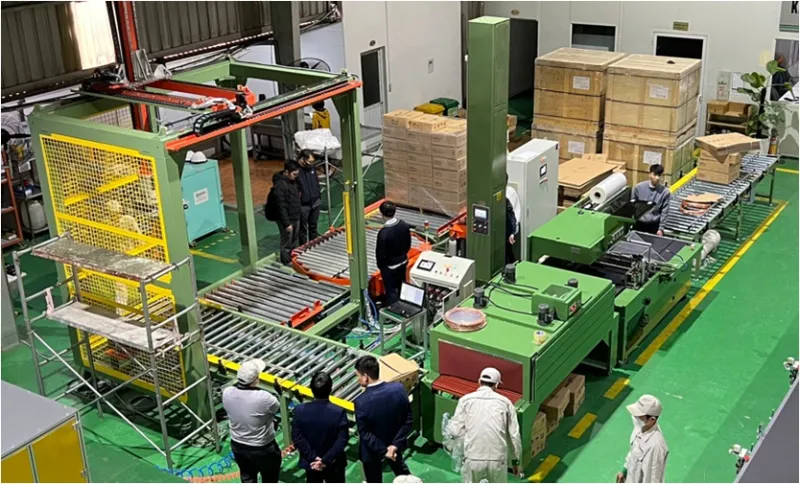
With modern design and advanced features, the Jig return conveyor not only meets international standards but also delivers outstanding performance in productivity and operational cost efficiency.
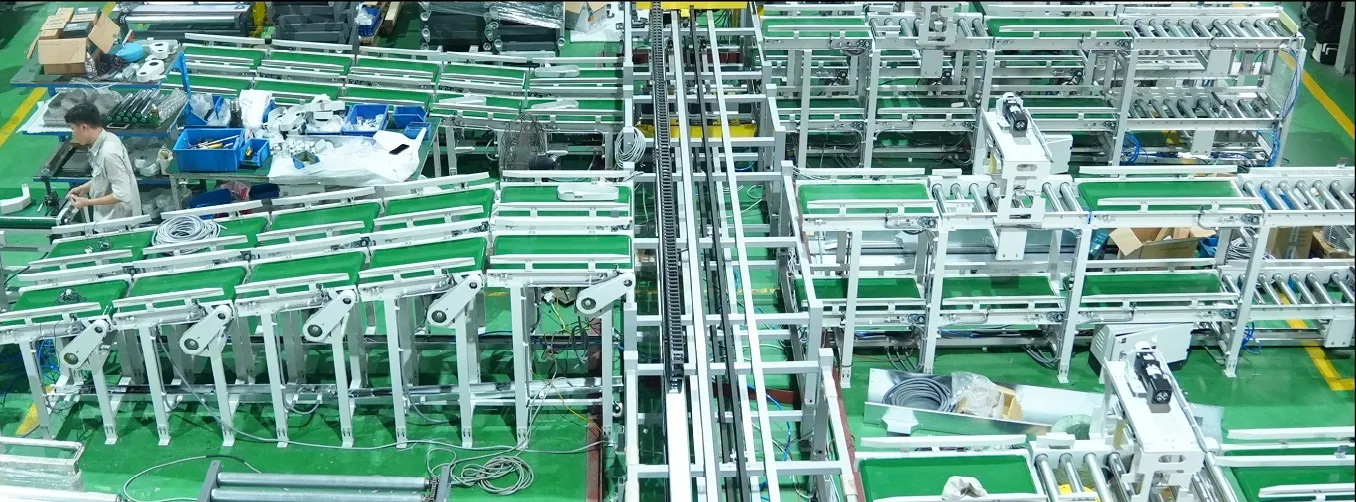
Overview of the 25m Jig Return Conveyor Project
This 25-meter Jig return conveyor system was specifically designed and implemented for a Canadian factory operating in Vietnam. The factory operates in industrial manufacturing, requiring high precision in assembly and product inspection processes.The conveyor system is designed to transport operation Jigs—specialized trays holding products throughout the production process—through multiple workstations automatically and continuously. With a total length of 25 meters, the system is optimized for continuous production while ensuring flexibility and high efficiency.
Main Components of the Jig Return Conveyor System
- Free-flow chain conveyor system: Enables smooth and precise movement of Jigs through workstations. This technology minimizes friction and ensures stable operation, ideal for complex assembly and inspection tasks.
- Control button at each station: Each workstation is equipped with a control button, allowing operators to move the Jig to the next stage after completing their task. This improves production control and flexibility.
- Lighting system and overhead rack: Provides sufficient lighting for assembly and inspection operations under optimal conditions.
- Jig return mechanism: At the end of the line, once the finished product is removed, the empty Jig is automatically returned to the first station via the lower conveyor system, ensuring a continuous production cycle.
Working Principle of the Jig Return Conveyor System
- Starting at Station 1: The Jig containing products is placed at the first station for assembly or inspection.
- Transfer to the next station: After completing the task, the operator presses the control button, and the free-flow chain conveyor moves the Jig to the next station.
- Process repetition: This process repeats across all workstations, each assigned a specific task.
- Return cycle: At the final station, the finished product is removed, and the empty Jig is automatically returned to the starting point for reuse.
Advantages of the Jig Return Conveyor System
– Labor saving:
– Production control:
– Increased productivity:
– Continuous cycle operation:
Project Significance
- Enhances domestic manufacturing capability
- Meets international standards required by Canadian factories
- Promotes automation and digital transformation in production
Applications and Future Potential
The 25-meter Jig return conveyor system is suitable for various industries, especially those requiring complex assembly and inspection processes such as electronics, automotive, medical devices, and high-tech manufacturing.With flexible design, the system can be customized in length, number of workstations, and integrated with advanced technologies such as sensors, monitoring systems, and production data management.
In the future, such systems can be further enhanced with AI and IoT technologies to enable real-time monitoring and optimization, helping factories improve productivity and meet global market demands.